Home › Co-owner & partner split tracker
Co-owners & partnersRental property co-owner & partner split tracker (US & Canada)
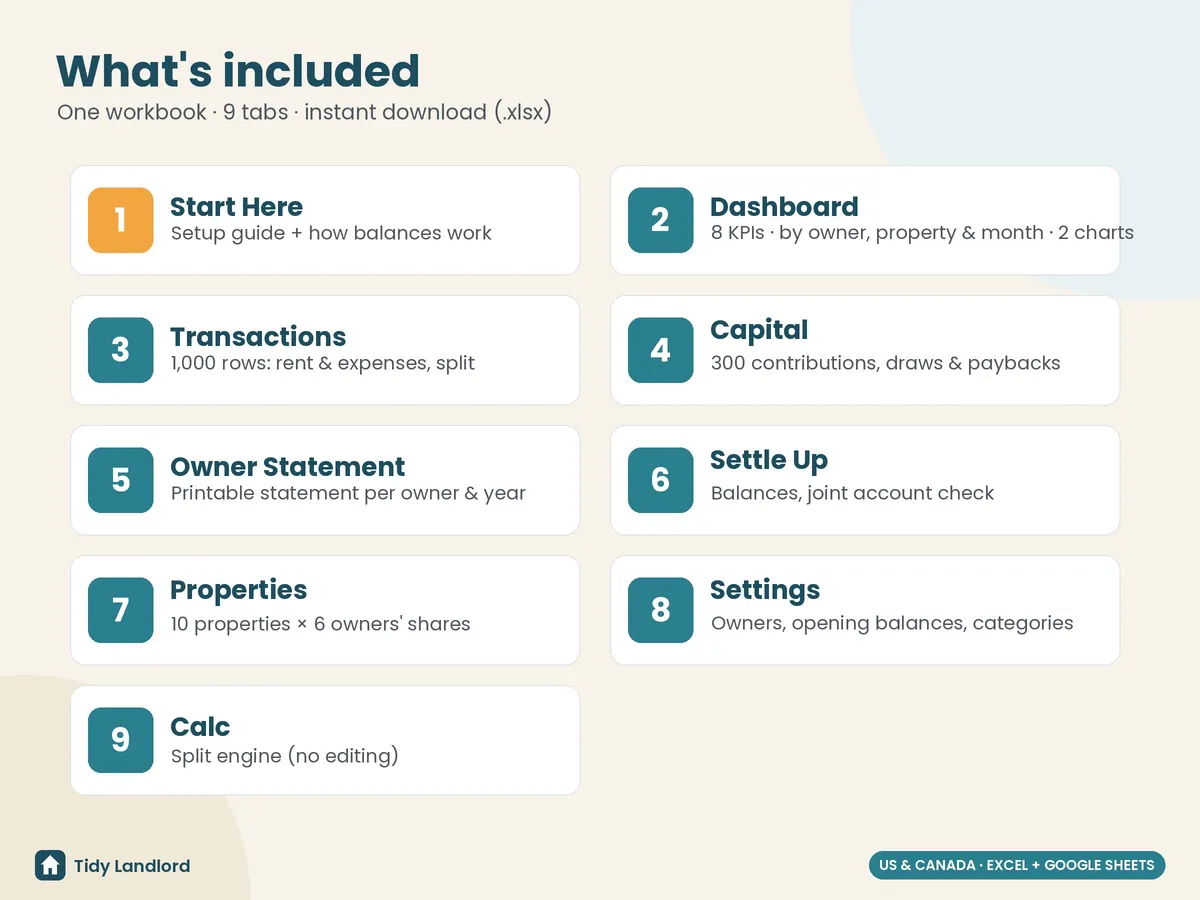
Own a rental property with your spouse, siblings, parents or friends? Track every rent payment and bill once, split it fairly between the co-owners, and always know who owes whom. A rental property co-owner and partner split tracker for the US and Canada, in Excel and Google Sheets, with a printable statement for each owner and their share of the income and expenses by tax line. Built for up to 6 co-owners, 10 properties, 1,000 transactions and 300 contributions / draws, with 20 categories you can rename.
Instant digital download (.xlsx). No macros, no subscription.
What you get
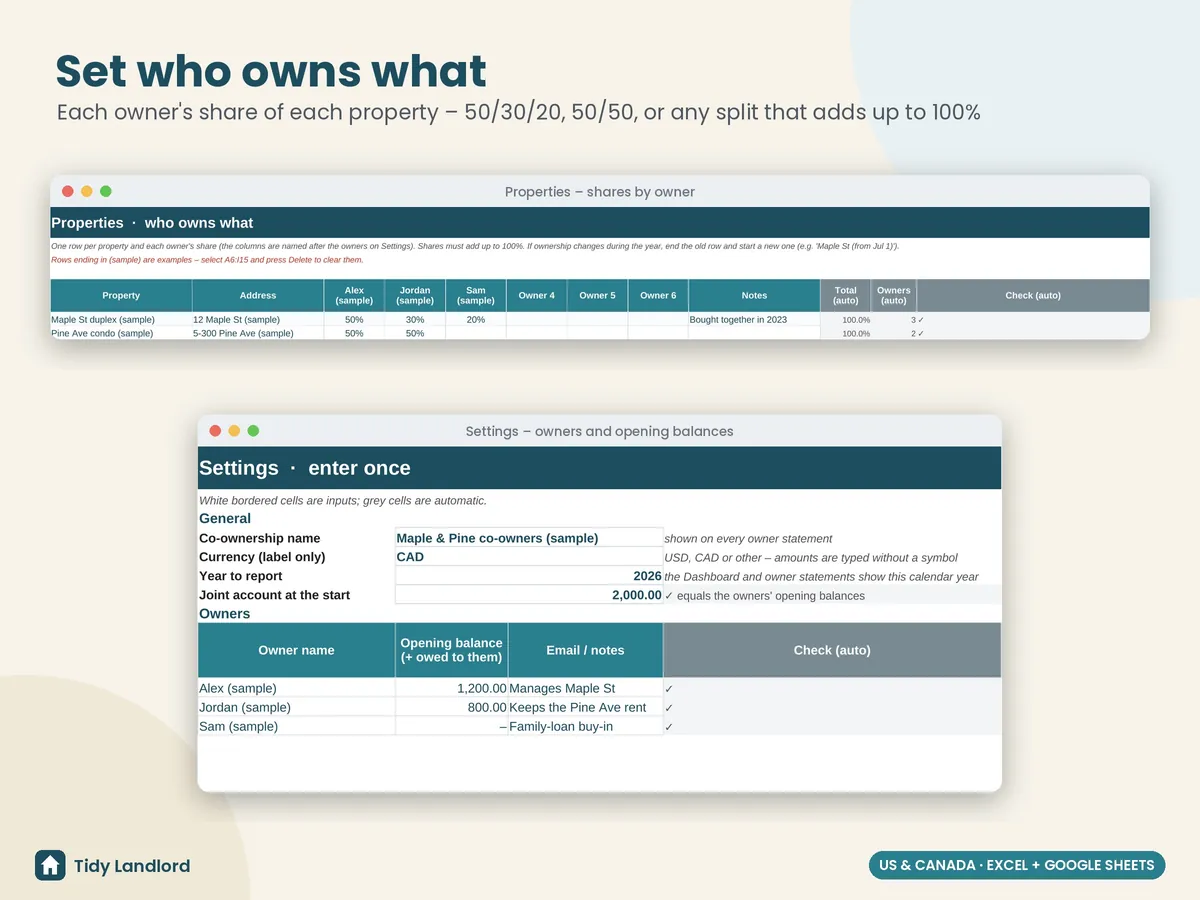
- Settings for the co-owners and what each one had in the joint account at the start, the report year, a currency label and the categories, each mapped to its US Schedule E line and Canada T776 line (rent, mortgage interest, property tax, insurance, repairs, condo / HOA fees, utilities… plus mortgage principal and improvements kept as not deductible)
- Properties: who owns what, with each owner's share of each property (50/50, 50/30/20 or any split that adds up to 100%). Ownership changed during the year? End the old row and start a new one
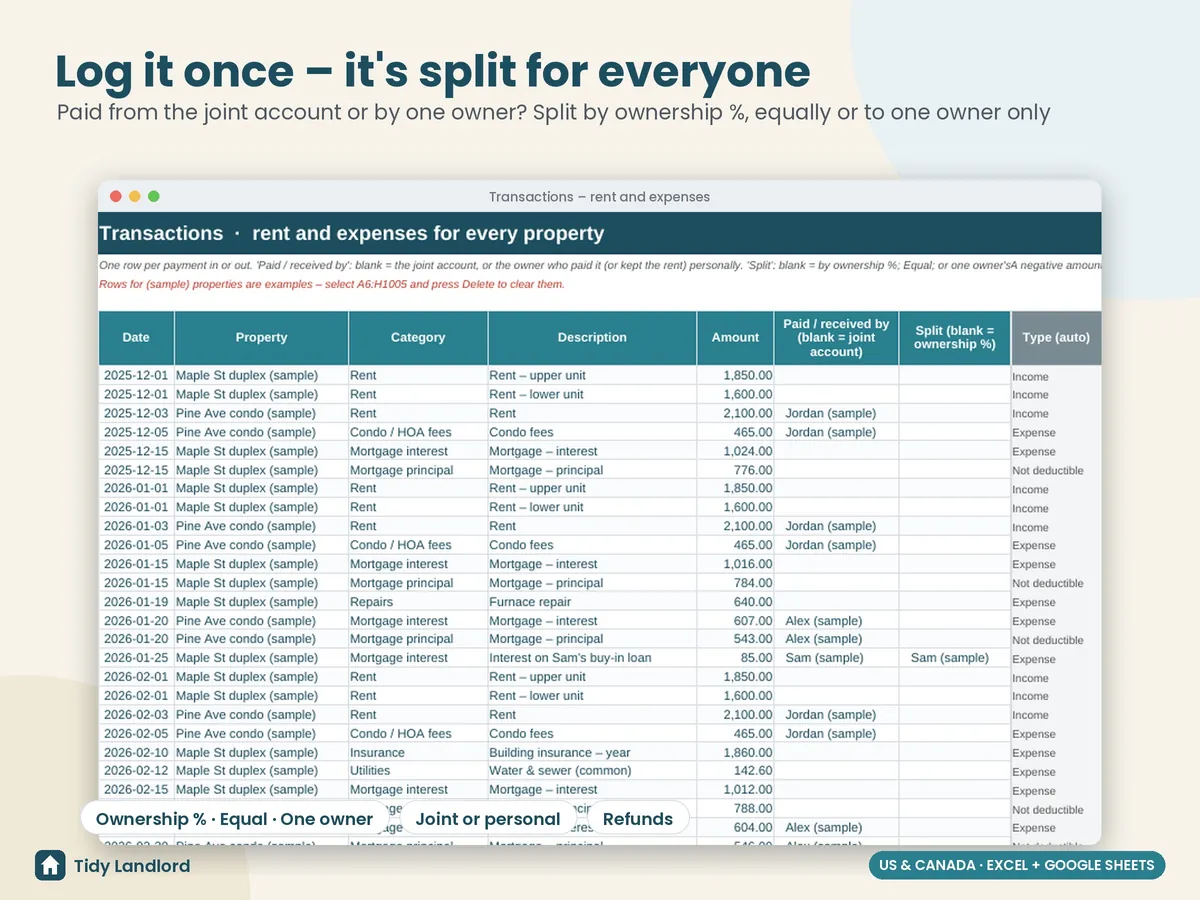
- Transactions, one row per rent payment or bill: date, property, category, amount, who paid or received it (blank = the joint account, or an owner who paid personally or kept the rent) and how to split it: by ownership % (the default), equally, or to one owner only (e.g. interest on a loan only one of you took out). Negative amounts are refunds
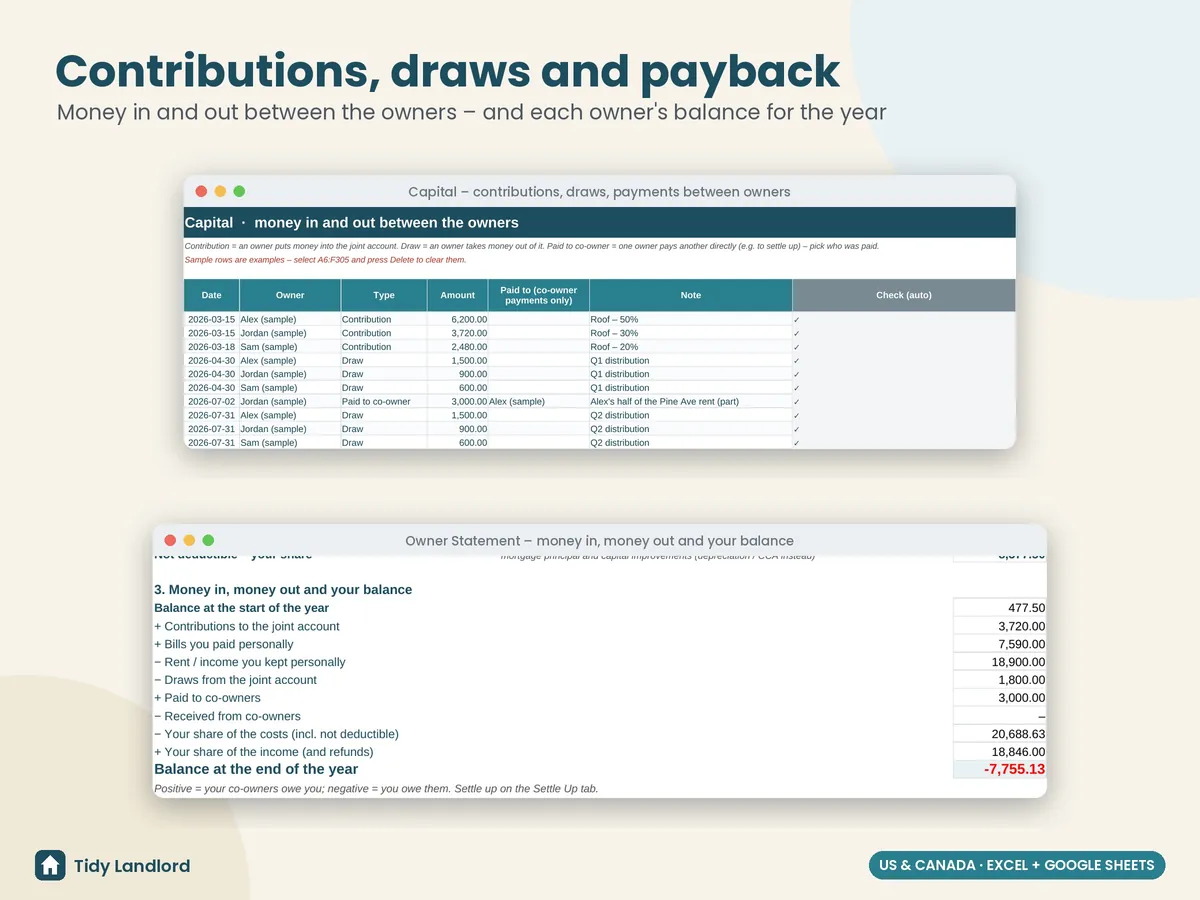
- Capital: money moving between the owners and the property, with contributions into the joint account (a down payment, a new roof), draws out of it, and payments from one co-owner to another to settle up
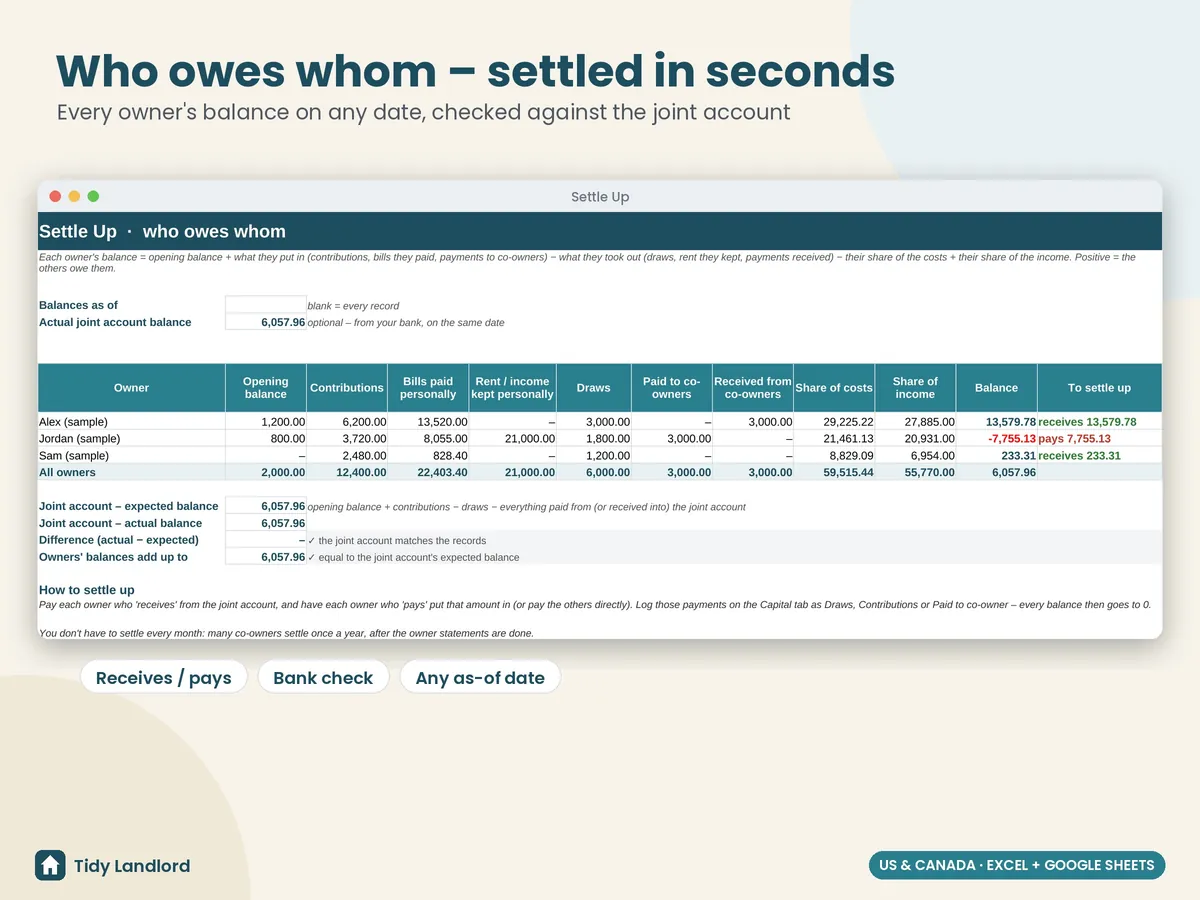
- Settle up: each owner's balance on any date, with what they put in, what they took out, their share of the costs and of the income, and a plain “receives X” or “pays X”. It checks the total against the joint account's expected balance; type your bank balance in and it shows the difference
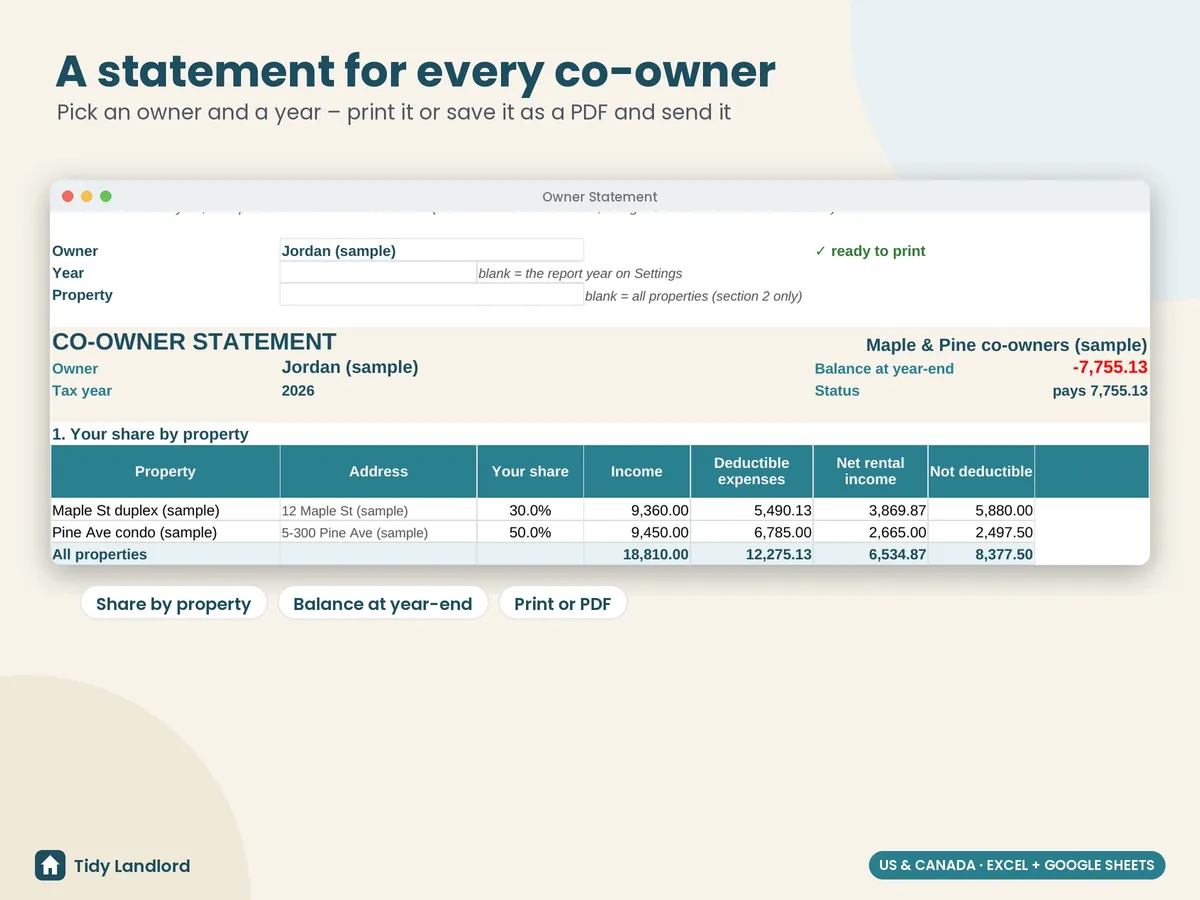
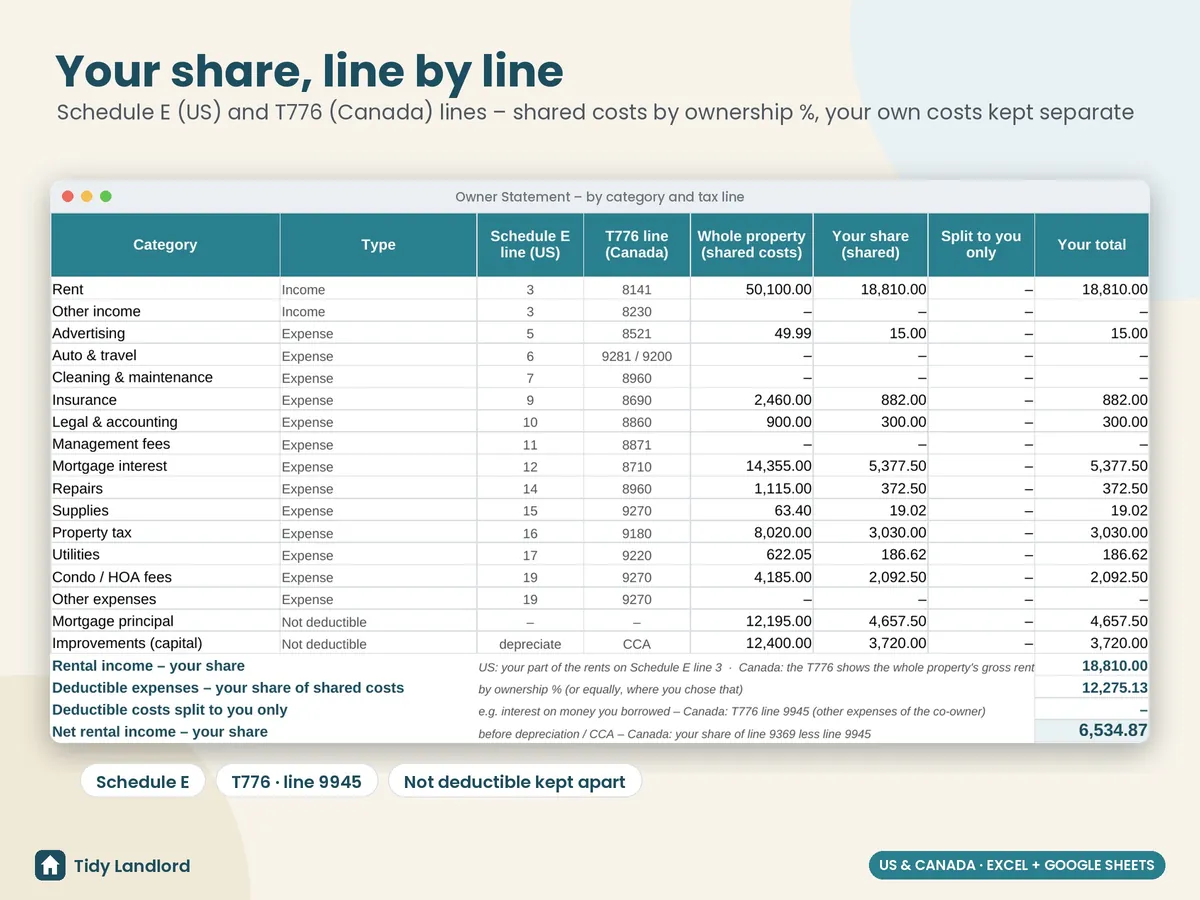
- An owner statement: pick an owner and a year to see their share by property, their share by category with the Schedule E and T776 line next to each one (shared costs by ownership %, costs that are theirs only kept apart), net rental income, and money in, money out and their year-end balance. Print it or save it as a PDF and send it to each co-owner or their accountant
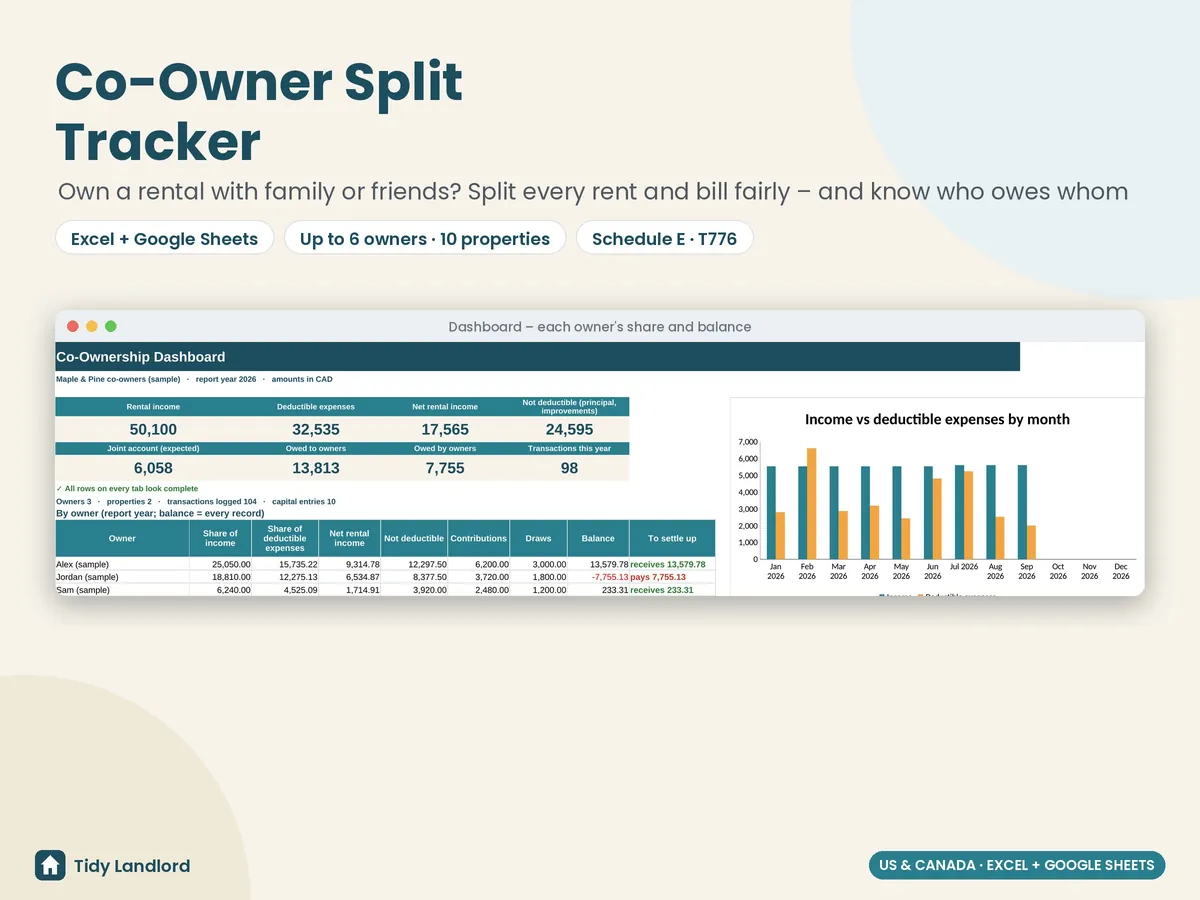
- A dashboard with income, deductible expenses, net rental income and not-deductible costs for the report year, the joint account's expected balance, what's owed to and by the owners, tables by owner, by property and by month, and two charts
- Check columns that flag missing or unknown properties, owners and categories, shares that don't add up to 100%, bad dates and text in number cells; the dashboard counts them for you
- A Start Here guide in plain English, with how the balances work step by step, to set up in about 15–20 minutes
Details
- How the balances work: each owner's balance = what they had at the start + their contributions + bills they paid personally + payments they made to co-owners − rent they kept personally − their draws − payments they received from co-owners − their share of the costs + their share of the income. Positive means the others owe them; negative means they owe. All the balances add up to what should be in the joint account
- Up to 6 co-owners, 10 properties, 1,000 transactions and 300 contributions / draws; any currency label
- Cash basis for the report year, by calendar year
- Excel 2010+ and Google Sheets, no macros, no add-ons, no subscription
- Tested formula by formula against an independent model (ownership changes, a 4th owner joining, every split and payer type, capital moves between owners, six owners, cleared data and edge cases), in LibreOffice and live in Google Sheets
- Not accounting software: the numbers are only as good as what you enter
Screenshots
How it works
- Buy on Etsy and download the .xlsx file.
- Open it in Excel, or upload it to Google Drive and choose File → Save as Google Sheets.
- Delete the clearly marked sample data, enter the owners and properties, then log each rent payment, bill, contribution and draw as it happens.
Free guide: How to fill out Form T776 (co-owners, lines 9369 and 9945)
This is a record-keeping and calculation tool, not legal, tax or accounting advice, and it is not a co-ownership or partnership agreement: write down how you share costs, decisions and a sale, and get advice on it. Taxes: in the US, IRS Publication 527 says that if you own a part interest in a rental property, you report your part of the rental income and can deduct the expenses you paid according to your percentage of ownership; if a co-borrower received the Form 1098, you report your share of the mortgage interest with a statement. A co-owned property run as a partnership or LLC that files Form 1065 (K-1s) isn't covered by this template. In Canada, CRA guide T4036 says that co-owning a rental as an investment is usually not a partnership: each co-owner reports their share on Form T776 (their share of the net income on line 9369, expenses only they paid such as interest on their own loan on line 9945, and the other co-owners' details in Part 2), and only the owner who borrowed can claim the interest. Depreciation / CCA isn't calculated here. Please check the current rules for your situation, or ask a professional, before you file. It was designed with the help of AI tools, then reviewed and tested before release.